Author Archive

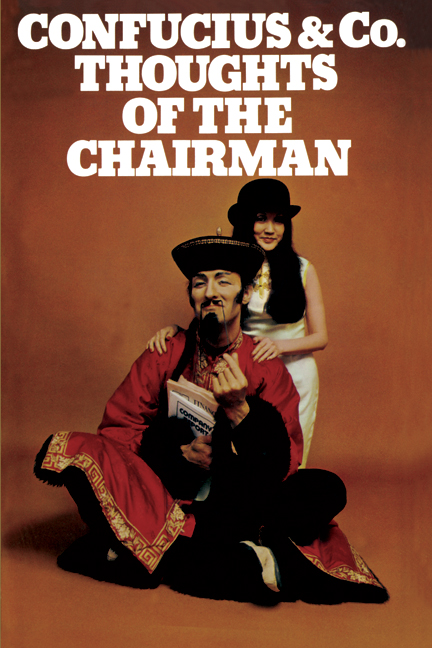
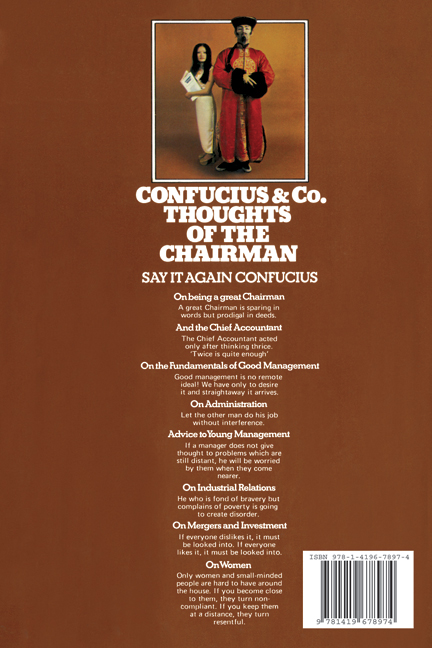
CONFUCIUS & CO.

About the Confucius & Co. Thoughts of the Chairman

‘Because business books are generally so hard to read, I was searching for different writing styles when I came across The Sayings of Confucius. Confucius lived between 551-479 BC and taught the future business administrators of China’s Emperors and ruling elite. As I read his sayings, I realized I was in fact reading a business book. Topics were recognizably modern business topics; and certain individuals in his text consistently spoke in particular ways and on particular themes. One sounds like a Finance Director, another like a Marketing Director and so on. It was a short step then to adapt the text to the modern business idiom yet still retain 98% of the original Confucian sayings in their English translation.

‘On a final note before you begin to read, for me the real pleasure and durability of Confucius lie in the thoughts and references that spring to mind as you read his words.’
Philip R Lund

Review

‘Confucius wrote at length during his life (551-479 BC) about administration with a degree of humanity and wisdom which is still lacking in much of our thinking today. The author of this book, by skilful rearrangement and substitution of setting, enables the reader to relate Confucian wisdom to current business practice – an inestimable piece of work.’ Wilfred Brown – author of Exploration in Management


USA buys from www.amazon.com
UK buys from  www.amazon.co.uk


The Sales Bible – Compelling Selling

Look at the copyright ‘frontispiece’ in the first Macmillan Papermac edition of Compelling Selling.

This is why “Compelling Selling, The framework for Persuasion” has been known as the Sales Bible in the Sellers’ Community. First published in the UK by Macmillan and the American Management Associations in 1974, it was apparently the first UK book on “Marketing” since the War to cross the Atlantic to be published in the USA by AMACOM.

Look at the number of editions (3) and reprints (7). Clearly a message that helped thousands of new and experienced “sellers” to raise their sales’ game.

In 2007 (2011 in the UK?), the sales task was passed to Amazon and Amazon Kindle with a 4th edition which showed the same ageless Compelling Selling skills in the scenarios of a more modern sales world. If you wonder about it’s efficacy as a sales text, read all the 5 Star reviews in Amazon.com and Amazon.co.uk. And if you still have doubt, look at the number of authors who have decided they can gain advantage by using the same book title as in my copyright.

Good reading. And good selling


http://www.compellingselling.co.uk/buythebook.htm

A sales life

I’ve just managed to find my was back into Linkedin. They told me my computer programme was out of date!

What a pleasure it has been to find my way back to old friends, many of them reminiscing on the fun they had had and their learning from our sales outings together. Many had read Compelling Selling (on Amazon Kindle) but I was impressed how many had taken away from our customer meetings key ‘persuasion’ themes that had changed the way they went about their relationships with clients and colleagues.

It made me think that for them books on selling were perhaps too long to fit into their busy lives. Maybe they would be better with Keynotes for Compelling Sellers, also available of Amazon Kindle. Here I have precised Compelling Selling, breaking it down into its key themes, with a few kind words from Confucius added. Ideal for trained and experienced sellers to review whether they are maintaining and even augmenting their presentation. But this is ideal too for people without formal experience who are dealing with current and future customers. It provides the pathway to a successful sales conclusion which needs to be clearly in your mind: what do I do now, how do I check I have done it successfully; and what do I do next?

I add this thought too. You and your colleagues, who are your company’s contacts with customers, should be meeting together formally & regularly, like once a week, and debating in detail how your customer meetings progressed both in objective and achievement. And at each meeting you should take time to agree & talk through a key sales theme from Keynotes for Compelling Sellers. It’s an important way if you’re going to learn and develop the team progressively.

Sell well

http://www.compellingselling.co.uk/buythebook.htm

A handbook for the professional seller

Most Helpful Customer Reviews

***** 5.0 out of 5 Stars, Amazon

“How To Make More Sales”

By Tony Jones on 18 May 2012

This is a good book, a very good book. I first read Compelling Selling many years ago and of all the books on selling I had read it was, and still is, the best. And although I had re read it several times over the years, it was only when I read Keynotes that I realised how little of what I had learned I was actually putting into practice.Keynotes made me realise how lazy I’d become and that I wasn’t structuring the sale properly. When you’ve been selling a long time it’s easy to get into bad habits and reading it reminded me of how I should be approaching the sale process.It’s too easy to be unstructured; you have a pleasant conversation and end up believing that if the prospect likes you, you are going to take the order. And it doesn’t work that way. Without a well structured approach to the sale you will end up having a lot of pleasant conversations going nowhere. So whether you are new to selling or someone who has been selling for years, buy this book, you won’t regret it.


***** 5.0 out of 5 Stars, Amazon

“Selling… the greatest story ever sold……”

By Bob Morris. FCIM. CCMI on 7 Mar 2012

This book is the ultimate companion for all salespersons and for all those who are simply trying to persuade others, be they peers, employees or their bosses.

The key sales techniques and avoidable pitfalls that all good sales people know, but often forget, are here in this slim pocketbook and could produce a couple of memorable sound bites if scanned just before going into that important presentation.
Like Napoleon’s baton, every salesperson should have this book in his knapsack and every parent should give one to their children on their seventeenth birthday.
Implement the advice in this book and every aspect of your life should improve.


***** 5.0 out of 5 stars, Amazon

“The final piece in the jigsaw of sales…”

Reviewed in the United Kingdom on 3 February 2012

A fantastic read and of huge value to all those in sales…its punchy and easy to read format allows you to ‘pick up’ and ‘put down’ at your leisure and acts as a great road map to making that all important sell. Digging deeper into philosophy of selling this book has given me the confidence and know-how to convert interest into a sale.

Compelling Selling will take pride of place on my desk for years to come!

http://www.compellingselling.co.uk/buythebook.htm

COMPELLING SELLING – Book Reviews

Most Helpful Customer Reviews

***** 5.0 out of 5 stars, Amazon

“A Most Effective Selling Method”

Reviewed in the United States on June 1, 2022

When I read and implemented the information in Lund’s book, it propelled me up to the very top of the sales in my company. Believe the info in this book and use it and your sales WILL improve!


***** 5.0 out of 5 stars, Amazon

“A M A Z I N G ! ! !”
Reviewed in the United Kingdom on 2 November 2018
It’s the writen proof that selling is timeless!! It’s SOOOOOO much better than the “new stuff” that’s made this days in order just to confuse and to sell a “nem way of selling” that nobody needs. Amazing!


***** 5.0 out of 5 stars, Amazon

“Amazing book”

Reviewed in the United States on December 11, 2012

This book is a remake of an older one that I have. This version has been improved with some visuals. The information is still absolutely amazing.


***** 5.0 out of 5 Stars, Amazon

“Don’t re-invent the wheel!”

By Ivor Neil Coward on 23 Mar 2012

40 years ago Philip Lund, a Harvard Graduate and expert salesman, homed in on the core issues of selling. The result was the outstanding hands-on book for everyone who wants to persuade: Compelling Selling. In the intervening thirty years, a lot of changes have rapidly taken place. But the knowledge of the workings of human persuasion can be still distilled into a few key areas and steps. This is what Philip has done: kept the invaluable core material but made it relate to us in today’s world in his republication of the original masterpiece. This book fires you up with enthusiasm but not hot air. The highly organized and analytical mind of Lund keeps your feet planted firmly on the ground and, importantly, the orders rolling in. Buy it today and you’ll never regret it. I still have my copy from the 1970s and have mentioned it and waved it at many people over the years. I’m not kidding, it’s the best book I’ve ever read on sales (and I have read a few in my time!). Don’t reinvent the wheel, just keep it true! Ivor Coward (Brit living in Venice Italy)


***** 5.0 out of 5 Stars, Amazon

“Do you want to make more money selling?”

By DanMan on January 4, 2007

I bought this book back in the 1970’s. It’s been my manual or Bible ever since. Lund knows his craft well and is able to explain it in clear concise language. This book changed my whole approach to selling, because in my opinion he began the whole principle that instead of blabbing about: product, feature, benefits; he shows how a series of questions will allow you to discover the “what” the prospect is buying from a product stand point and the “why” from his own personal and professional perspective. The “why” gives you the emotional reasons behind the purchase and this is where you can yield incredible power over the sales process.If selling to corporate customers, purchasing large ticket items requires you to get each influential executive’s needs and requirements and then address them individually. Lund is a master of questioning that permits the customer to tell you exactly the what and the why he is buying. It’s kind of like the story of the 7 blind men descibing an elephant. One thinks the elephant is lke a large snake, because of it’s trunk, another thinks the elephant is like a tree trunk, because of his large straight leg etc. This is what selling to large corporations is like ,as well as, small companies and individuals.Lund also goes over the trial close, as the key to taking the customers temperature and commitment and handling objections and all the other things you must know to be at the top of your game, but he does it in such an interesting way that you will go back to this book again and again. It made me a top 10% performer in several Fortune 100 company sale’s forces and much of what is in this book helped me achieve this.Read more ›


“A truly excellent sales manual.”

By A Customer on February 28, 1999

Mr Lund exudes real-selling life experience and gives a true boost to all sales professionals. Down to earth, practical, funny and inspiring, I have had this book in pride of place in my office for 10 years and it’s still the best one I’ve ever read.


***** 5.0 out of 5 Stars, Amazon

“Excellent Sales Reference”

By James P Higgins on April 5, 2012

This is an excellent read and provides a well-rounded review and reference of all aspects of the sales process. Few books cover the `shape’ of the sale as well as this text. For the salesman or woman who frustrate themselves by attempting to close too early or who just don’t understand why people will not buy from them, this is a must read. As the author explains in the introduction, the book repeats at times, for effect and to make the message stick as much as anything else. I didn’t really need this although it didn’t distract from the reading. I would recommend this book because it provides a basis and an understanding of what sales is about; ‘a logical process which achieves an emotional objective’. Having spent the first chapters explaining what makes people buy and how to identify the real customer, the author then sets out to describe the over-arching sales process using how-to examples and recommendations: how to develop an effective sales plan, how to use questioning techniques and communication styles in order to understand the needs of the customer, how to structure sales information to create a pipeline and structure reporting, how to handle competition and objections and finally how to close the sale. This is a great reference book for both the frustrated salesperson looking to understand what or where they may be going wrong or equally for successful sellers who need the odd reference from someone who has been equally successful in the world of sales. James Higgins, CEO, Cincinnati, USA


***** 5.0 out of 5 Stars, Amazon

“A framework for persuasion indeed”

By Bob on September 6, 2010

This book is clear, lucid, well-organized and highly informed. Read, re-read and highlight it. Top salesmen will learn things and be reminded of what they may have forgotten. Newer people will have a strong foundation on which to build. Recommended.

By Amazon Customer on December 11, 2012

This book is a remake of an older one that I have. This version has been improved with some visuals. The information is still absolutely amazing.


**** 4.0 out of 5 Stars, Amazon

“The Selling Classic”

By B. W. Ramsay on 2 Dec 2007

The art of persuasion – people selling to people – does not change over time. While some have tried to formulate the process with mnemonics and software, this often just dilutes and over simplifies the time-honoured practice of selling. Compelling Selling is the definitive classic on the subject, and an absolute must for anyone who wishes to learn to actually sell successfully, and not just to tick boxes on multi-coloured forms.


***** 5.0 out of 5 Stars, Amazon

“Eccellente”

Reviewed in Italy on April 4, 2016

Scrivo in italiano ma sono inglese, come lo è il libro. Il libro di Philip Lund è un manuale che ogni venditore dovrebbe avere. L’ho letto 30 anni fa ma non ha invecchiato. La concretezza e limpidezza della mente del laureato a Harvard con pluriennale esperienza a sviluppare vendite straordinarie in più settori traspare da ogni pagina del libro. Ho letto almeno 30 libri qualificati in argomento e tutti sono utili per motivi vari ma il mio punto di riferimento e Compelling Selling. Compelling perché ti aiuta con suggerimenti concreti per ogni tappa: dalla preparazione del territorio alla telefonata di canvassing, dai primi minuti dell’incontro alle tecniche di chiusura, dal tenere i clienti al riassunto motivazionale, il contenuto è un distillato di una carriera di una persona che, nonostante la lunghezza del testo, non ha sprecato una parola sui lungaggini soliti. Ci tiene semplicemente ed efficacemente fermi sugli obiettivi. Buona lettura, buon successo.


Testimonials

Subject: To Philip Lund – a note of appreciation
Sent: Tuesday, January 08, 2008 2:52 AM
Dear Philip,
A short note of appreciation for you.

Before I went for my first sales job interview with a prestigious medical organisation in 1987 in the UK the headhunter told me to get and read “Compelling Selling”. I did, got the job despite having zero sales experience and tough competition, and still have the engraved watch I was given for sales achievement in my first year.

You therefore had a profound and positive impact on my career development – THANKS!

Now that one of your other fans has pointed out that you have a latest edition I will be sending one to each of the team in my own company, for whom I hope it will help to achieve the same success.

Kind regards

Laurence Heron
Managing Director
Focus Medical Technologies

http://www.compellingselling.co.uk/buythebook.htm

HMS CERES

So the time had come.  We were off to HMS Ceres to earn our gold star Writer’s badge.  Sounded hopeful too.  Ceres: the Greek Goddess of Fertility no less (or was it TV Programmes?).  HMS Ceres was a brick battleship, the type that doesn’t float but doesn’t sink.

HMS Ceres was in Wetherby in Yorkshire.  It’s a lovely part of the world.  Near Harrogate, near York and its magnificently Gothic Cathedral, near Ripon Cathedral, with its Saxon Crypt, and Fountains Abbey, the beautifully preserved but ruined Cistercian Abbey; and, indeed, near Wetherby Race Track.  We even took expeditions into the Yorkshire Dales, hopping from rock to rock as the streams gurgled beside us.  In fact one chap fell over on the rocks and ignited a box of Swan matches in his trouser pocket.  For a while he did a bit more hopping about than the rest of us.  The downside was Wetherby was very cold in winter, at least for those sailors who hailed from ‘south of the Thames’.

The camp itself was charming too, all low level buildings, pathways running between them with little green verges and rose beds bounded by diagonally-set bricks.  If people weren’t walking around in uniform, we might of thought we were somewhere else. It was all very relaxed.

One day two of us were walking with the rubbish bin between us having just emptied it.  A trainee chef with a beaming smile decided it was such a lovely day he would run up from behind and jump over it.  Would we mind? No, we said.  What skills he had in cooking evidently did not rely on logic.  He hadn’t worked out that, from the moment he took off, we would have walked on a couple of steps while he was in the air.  Sure enough, up he galloped, took off and landed right in the middle of the empty bin, the whole lot going head over heels.  We were shaking with laughter as we walked on while he sat on the path rubbing away at the bruised bits.

As you walked in the gates of HMS Ceres, generally speaking the billets or dormitories were to the left.  To the immediate right was a huge parade ground, facing inwards with the large flag pole centre edge and, behind it, a low level brick building, with a small rectangular water tower in the centre of the roof.  The officers would step out with this building behind them in full uniform and address the morning parade facing them.  The guard would present arms.  The Union Jack would be unfolded and raised on the pole.  The parson would hold prayers.  We would all sing a hymn or two to a small mobile organ which had been pushed out and opened ready. Then we would march past stiffly with the officers returning the salute.  Something like that anyway.

The dormitories were like Nissen huts, quite comfortable with double bunking beds end-to-end down each side and a double row of steel lockers facing outwards down the middle.  Toilet and wash facilities were the other side of the entry door at one end.  I chose the upper bunk as near to the door on the left side as I could.  I had already learned, when right handed people walked into a room like that, they tended to turn right; and most people are right handed.  This gave me a few seconds more in bed most mornings.

The biggest problem with the dormitories was we had to share them with the trainees chefs who were also trained at HMS Ceres.  Chefs tended to be rather more basic than us Writers and, when they got drunk, occasionally chose to piss in their own lockers rather waste sleep time staggering off to the toilets.  If you were unlucky, they mistook your locker for theirs.

We hadn’t been to Ceres long before our Chief Petty Officer (CPO) gave us our welcome and our warning.  There was a local young lady, he said, who couldn’t wait till evening leave time came to earn her pennies.  She had taken to offering herself through the surrounding chain linked fence.  Our CPO gave his advice with these succinct words.

” She’s got it, you want it.  She’s got it, you’ll get it”.

For our group, that was advice enough.

Our group was a nice bunch, mostly quite well educated and from all over the country.  There were 12 of us.  We would all take of evening ‘shore’ leave together.  That meant 12 pints of beer which was pretty inebriating; and you had to be careful.  You had to be able to walk back through the gate and check in unaided.

On one of this outings, one of the guys became desperate for a crap.  He dived behind a hedge.  We were well in the country.  He came out smiling and off we all walked together back to the camp.  Suddenly, after about 300 yards, he discovered he had left his belt behind, a pretty difficult thing to do.  Navy belts are wide bits of webbing which go round your waist to be locked in place by the front flap of the trousers.  Anyway, back we all went.  He dived back behind the hedge and had some difficulty finding it.  Oops.  There it is.  Underneath.  He carried it back to the camp very gingerly.  I am not quite sure how we navigated it past the guard house.

Even now, after all these years, I remember those nights waking up, freezing cold, sitting on the toilet.

So life went on.  We were all given duties outside our training sessions.  Mine was cleaning up the kitchen vessels after meals in the camp cook house.  Those huge steel vats.  Not long, everything began to stink of rotten cabbage, you, your hair, your clothes.  You took them off at night.  They stunk at the end of your bed.  And you put them on in the morning. You just couldn’t get away from it.

The other side of it was the long waits between meals and washing duties.  We used this time playing draughts.  Endlessly.  Draughts.  After a month or so, everything I saw became draughts.  I’d stand talking to people and, before long, my mind was moving them around on a draughts board; and, when I slept, the same games were played over and over again.  It took months afterwards to get it out of my head.

When I was relieved these duties, I became one of the camp gaolers.  I had to sit in the cells and make sure everyone had what they needed!!  The camp had quite a big, residential contingent just to keep the place running.  Inevitably, some of these transgressed and some got locked up.  Most of them had tattoos; and most of the tattoos were pierced hearts or scrolls with the mother’s or girl friend’s name; or vertical swords and banners with things like Death before Dishonour written on them.  It was here I discover how unbelievably hard some of these kind of guys are.  There was nothing, absolutely nothing, that would make them change their mind – no insult, no hardship, no bribe.  They were resolute.

Some of the guys in the cells were there, trying to work their ticket, trying to get out of the Navy.  In those day, there was a 12 Continuous Service contract.  They would sign on at the age of 16 as a boy seaman.   You see them in those old photos standing on the top of the mast.  But the contract didn’t begin until they were 18.  By 19, they hated the place and wanted to get out.  But there was no way out.  They couldn’t usually buy their way out, even if they could find the money.  So the choice was to do things where the penalty was detention for 13 weeks.  Three of these and you could be chucked out.  So some of them would go out and pick fights with shore patrols, do their three months, take a rest, have a few beers; and then set about a valuable bit of Naval property, like a kitchen with a fire axe.

Another way was to piss in your bed.  As we know, some people have this problem they can’t help. The Navy couldn’t have people in a mess at sea pissing in their hammocks, then trussing them closed for storage.  Clearly it would be a health hazard, even if you could cope with the flies.  So the brighter ones would have a good night’s sleep, then piss in their bed before they got up in the morning.  One of my ‘cell’ jobs was to go round every hour through the night, wake them up and ask “Want a piss?”  It was then a question who would give in first.

As we know, all good things must come to an end.  We had passed our exams.  In the next few days we would graduate.  The question then was what could we do to be remembered  at Ceres forever.  We formed discussion groups.  Over and over it we went.  Suggestions came and went.  Ho ho ho, we said.  That won’t work, we said.  We could put a live chicken in the organ.  We could fill the flag with confetti so it would blow all over the parade ground.  That’s nothing, we said,  That’s be done before, we said.  Then my friend Jerry Guiton came up his his idea.  Ho, ho, ho, we said.  That’s impossible, we said.

But not for Jerry. It was possible; and he had worked out the timings.  He must have been an engineer. I helped him.  We crept out in the dead of night.  We gathered bricks from the garden and built a low, false wall in front of the water tower on that low flat roofed building by the parade ground.  A mattress cover cut open made a 12 foot (3.7m) banner.  Jerry found 2 x12 foot sticks to attach to keep it open.  He found a ball of strong twine and a good number of vine eye hooks to run the twine through.  He was ready.  The night before our graduation day Jerry was up on the roof for the final touches.

We did not have to attend the parade on the day of graduation because we were meeting the Camp Commander directly afterwards.  We waited at the back of the long, low building, in fact just where the end of the piece of twine was hanging.  We heard the parade set up and we saw the officers step out.  This was the moment.  Jerry pulled on the twine.  Amazingly it worked.  Slowly a banner rose up in front of the assembled sailors.  Of course the officers couldn’t see it.  It was behind them.  Beautifully scripted the words said

GOOD MORNING CAMPERS!

Well you are not meant to laugh on parade or even smile.  You’re certainly not meant to laugh out-loud.  The guard of honour fell about about.  Arms didn’t present.  The morning service collapsed and, of course, those marching past marched past the banner, and those saluting saluted the banner.  Tears were running down the faces.  It was chaotic. I think the march past was made to run again.

Jerry.  You were a star and still a very fond memory.  And I have to hand it to the Camp Commander too.  We could have been in real trouble, maybe even cell dwellers.  But the Commander took it in good heart.  I suppose it is one of those thing, if you do it well enough, you’ll get forgiven.  He merely stated his suspicion we were involved, advised us that, if it was us, we would be better not to do something like this again, and formally handed us our golden Writer star.  We saluted, about turned and marched out.  Goodbye HMS Ceres.  You’re a fond memory too.

We we off for our first assignment, for me HMS Victory in Portsmouth.                      (To be continued 9/11)

JOINING UP

‘I joined the Navy

To See the World……

…..and what did I see?

I saw the sea.’

(Author’s note:  All this happened a long time ago.  What happened actually happened , but some of the details and timings could well be muddled)

It was my future brother-in-law’s fault.  He was still in the dating stage with my sister. We shared a bedroom when the family went on holiday to San Remo.  He was doing his National Service and had already made it to Sub-Lieutenant.  For a couple of weeks, when everyone had gone to bed, we sat around smoking his blue liners (Navy issue cigarettes with a blue line on them. 4p per pack!) while he told this ‘innocent’ all his eye-widening stories about life in the Navy.  In a nutshell, they all boiled down to this: all girls love a sailor.  It took me two years to find it out for myself: they absolutely don’t.  In fact they all run a mile.

The other decision factor was this.  At Haileybury, we all had a Combined Cadet Corps; and we had to do cadet training.  It was mainly about marching around, ‘judging distance’, and ‘presenting arms’ on Wednesday afternoons; but it was different on Field Day.  While the army cadets crept around, and did leopard crawl, in the mud & field ditches and in the rain, shooting blanks (and occasionally their foot), the navy cadets caught a bus to London to visit HMS President, built when ‘the ships were wood and the men were steel’ and ‘parked’ on the Thames.  After a bit of nosing round the gun decks and canons in the dry, there was usually time for a couple of pints before we set off back.  Game, set and match.  I signed on.

Inevitably the day of reckoning came.  I graduated from school, dug a few ditches for the toilet system for the London Bible College which was then in build.

(I must add a note here about Harry.  Harry was an Irishman who dug ditches.  In those days, we would all have a laugh about Irish ditch diggers who we always saw leaning around on their spades.  Well, let me assure you, Harry taught me what you see was not what you get.  He gave me the choice, dig the ditch or push the barrow.  If I dug the ditch, I had to keep up with the speed with which Harry took his barrow over the boards to empty it and to return for the barrow I was filling.  Or, if I did the barrow, I had to get my barrow back quickly enough over the slithery, slidey boards before the barrow he was filling became too heavy.  Whatever whichway I did it, and try as I may, I just couldn’t keep up with him; the easiest, most amusing day’s work Harry probably had ever done too).

The ‘Queen requests and requires…’ letter arrived.  I was a GUZ rating which means my home port was Devonport, as a probationary writer actually, clerical not seaman branch as I wore glasses.  I can’t quite remember where I signed on, Portsmouth, or Pompey as it is known, or Devonport; but I do remember vividly the gates of the Portsmouth Barracks ,with the huge crest above them, ‘Honi soit qui mal y pense’ or, as they say, ‘Evil is he who evil thinks’.  I cleared my mind of any bad thoughts, shrugged my shoulders and walked in, ‘prison’ for two, whole years starts now.

So initation at Pompey barracks was all about togging up to look like a sailor, marching around (I had become good at that), sloping arms and presenting arms; and settling into one of the huge dormitories. The dormitories were split into four sections, with double bunk beds in two rows facing each other, and a passageway through the middle.  Metal lockers in between and at the end of each bed.  Maybe, 15 beds in a row which meant 60 men in a section and 240 in the dormitory.

The toilets were at one end, of the modern flushing variety, OK until payday when half the place got Mozart (and Liszt or pissed) and continued to throw up in the stand ups which would go on flushing until we had a flood running out into the corridor and down the stairs.  Next day, broke, they would go round bumming pennies until they could afford two pints of scrumpy (high alcohol rough cider).  Then they could be back in the toilet again doing the same thing the next night.  Most sailors spent everything they were paid on outings; and moderation was not their forte.  As National Service men, I seem to remember we were paid 21 shillings and 6 pence (£1.075) each week from which we had two or three shillings taken out for social security!  This was 1957.  So it didn’t leave much to do anything with.

We had our inoculations at Pompey.  We lined up in a row and were injected.  I think it was smallpox that they dabbed on the top arm and gave us a little metal thing to pummel away at the spot.  Presumably the blood would rise up and take the antibodies into the body through the skin.  The trouble was they didn’t wipe the arm clean afterwards.  So we put on our heavy naval sweaters again and those with sensitive skins inoculated themselves again.  One guy even put his sweater on the other way round the next day and managed to inoculate himself a third time.  I think they called it double & triple vaccine poisoning.

Crabs and bedbugs were a bit of an issue.  The sailors cure for crabs, they say, is to cut a parting in the pubic hair with a razor, rub in plenty of alcohol and then some sand in the hope that the little critters would get pissed, start fighting and stone each other to death.  One hirsute leading seaman would come in to the barracks on his duty nights and be given a regular issue grey navy blanket.  Time and again he caught crabs in his body hair.  I can’t imagine what he used to tell his wife.

One of the first pieces of advice came from a Petty Officer.  There were only three things in the Navy that could really get you into trouble: rum, bum and ‘baccy (tobacco).

Sailors in these times would get a tot of rum every day.  It went back into naval history when a squadron of British fighting ships had saved a West Indian island.  In thanks, the islanders  had bequeathed the navy a supply of their heavy dark rum in perpetuity, either freely or for a peppercorn payment.  This meant every day, as we lined up along the hot plates to collect our lunch, we would pass a tray with these tumblers of rum on them, one part rum, two parts water.  After drinking it, you could feel your shoulders ache a little as a haze of relaxation came over you.  A sailor one day sat on the stainless steel food counter to drink his rum.  “Hoy” bawled a chef, “Gerroff.  This is for rissoles not arseholes”

You could get into a lot of trouble passing your rum around; but a wonderful subculture had developed around it.  Sippers (a monitored sip only) meant someone would do you a favour, gulpers (a monitored gulp) would probably get you off a night’s duty while, with the whole tot, you would probably never have a duty to do again.

At this stage, the navy hadn’t got its head around gay sailors or mixed sex ships.  These days they both are accepted.  But in my time there was always a fear that ‘love’ affairs springing up could affect the ship’s wellbeing and fighting capability.  Then, bum was a sackable offence.

Going back to bum and bedbugs, at one point I had a real issue with a bedbug.  Night after night, I would check out the bed before I got into it; and day after day I would wake up with patches of bites on me.  So this night, I went to bed with no pyjamas.  I woke up, in that half light you get around 2.00am near the sea, to see someone at the end of my bed going through my pockets, looking for my wallet.  “Oy” I shouted and off he fled with me, naked and in hot pursuit, yelling at the top of my voice “Stop that man”.  Down one side of the dormitory, up the other.  Heads popping out above the bedclothes.  Anyhow, to  cut the story short, someone else took up the chase, pursued him out into the parade ground where the guy was apprehended as I sloped back to bed.  The upshot was, he was brought forward for questioning.  Fortunately the ‘tribunal’ accepted my reasons for pursuing him through the dormitory naked, late at night.

‘Baccy’ was the blue liner cigarettes again.  The monthly issue was 200 at 4p per pack.  If you drank as a group, no-one missed their round of cigarettes either.  Knowing what we know now, it would be interesting to see an estimate of how many lives this privilege cost.  Buying someone else’s ration was strictly verboten.

But enough.  We were kitted out and ready to begin our Navy career.  Next stop HMS CERES (to follow 7/11)

Amazing place, India. Take the streets. Can you imagine  a dual carriageway, say 3 lanes each side with a centre barrier? No-one drives to lane but drives to the nearest point of most progress.  Not just cars but bikes, scooters, cars, rickshaw bikes, rickshaw scooters, camels/donkeys and trap, buses, trucks…all fighting it out, horns blowing to warn approach.  Then add in cows, buffaloes, bulls, dogs, goats, pigs and piglets, pedestrians in endless numbers, some of them sleeping in the inside lane, cattle eating the foliage on the centre barrier. Then add in the drivers who drive the wrong way down the wrong side because they can’t be bothered to find the gap in the intersection further on.  Even on the motorways out of town it is just the same but with bigger gaps in the crowd.

Flight went to plan and we were picked up at the airport. Stayed at the Lutyens designed art-deco Imperial Hotel, Delhi, the history of the  English Raj on the walls.  Over 4000 old prints.  Great room, great food. There you realise just how closely the Brits and the Indians work together, the level of mutual respect.

There in Delhi the first temples and the first palaces/forts: a tomb built for the second Mughal Humayun by his wife Mumtaz;  the Lutyens designed new city with its magnificent government offices.

Two days later, a short flight to Varanasi and the Nadesar Palace Hotel where the Maharaja put his guests. Again good food, fine room and wonderful service.

Varanasi.  You have seen nothing yet.  The street scenes above and halve the road sizes.  Varanasi, on the Ganges, the home of the Hindu religion – ritual washing in the Ganges for all Hindus, cows and fakirs everywhere, bodies burning on pyres on the banks, mourners running thru the streets chanting, bearing their loved ones on stretchers, cymbals clashing, the new arrivals dressed in bright shrouds, faces bare, heading to the final journey.

Walk behind these stepped banks (ghats) and you find two metre wide streets, vendors sitting in cave openings either side selling all sorts from ready snacks to a haircut. Dogs, cows. bulls, buffaloes again abound – you push on past them, dancing between the shit that lies everywhere.

We were there during the festival when Shiva in his various forms is taken to the Ganges and thrown in – adorned Shiva trucks, crowds dancing behind them, traffic to a standstill – destination abandoned; but how do you get out of this meelee?  Here too, a visit to Sarnath where Buddha preached his first sermon and set in motion the Wheel of Law. Buddhist groups from Shri Lanka winding a cloth band around the commemorative massive while other buddhists from other countries looked on

Second flight to Khajuraho. Lalit hotel good but disfunctional. Never mind. We are here to see the Hindu temples.  13th & 14th centuries exquisitely carved in stone and still perfect. Karma Sutra too. Conjoining of man and woman creates the ecstatic state on the road to Nirvana.  ‘There are 85 positions’, says the guide. ‘This is number 69.’

Now a drive to Orchha where the magnificent palace was built over 20 years for a one day visit by the Murghal Jehangir, then a 2.5 hour train ride to Agra made one hour longer by delay. The whole world on the platform.  We are sitting on our bags watching the rats busily at home between the rails, waiting for the train with a first class the whole Western world would not choose to travel in!  On the platform, waiting with us, an American architect and his wife who live in Mexico City, dressed in flowing while cotton robes; and an tweedy English solicitor and wife from Northwood Hills. Agra we are here.

Agra is the Mughal town of Akbar and Shah Jehan, both liberal Mughals who embraced religious and cultural tolerance. Akbar we hear had three wives, Hindu, Muslim and Jewish (plus a 300+ strong harem just in case) but his influence on art and building is there to be seen.  We stayed at the Oberoi, a super hotel in every way, every room with a view of the Taj Mahal.  Magnificent.  ‘A tear on the cheek of love’, the Taj is a ‘must-see’ in your lfe at some time.  Absolutely beautiful, pure white, hard marble, perfect symmetry, finely carved as wood and inlaid with semi precious stones. It seems to float.

Then forts and palaces in abundance, clearly an amazing wealth and culture – beautful design and finish on a grand, grand scale. People, beggars, hawkers everywhere.

Now for the nightmare car journey to Sawai Madhopur to see the tigers at Ranthambhore National Park, much of the road as bad as a farm track, the best bits with vehicles coming in every direction; and the usual crowd of dogs, cattle, bikes, dogs, etc.  Long and exhausting.

Arrived at the Maharaja’s Shooting Lodge later in the evening.  Hold it. This is’nt a Maharaja’s shooting lodge.  This must be where he kept the tigers.  Now, as you can imagine, Maggie is not one to be ‘penned up’ in a place like this. Her Beloved springs into action. Only the Oberoi Vanyavilas would do.

You should put these hotels up on Google. Look at this one.  Elephants on guard at the gate, awaiting intrepid tourists. We slept in a beautifully coutured, tent-designed bungalow, the daylight washing pale through a roof fabric embroidered with tigers in gold thread.  What a bijou experience! Dining in a luxurious courtyard with staff falling over themselves to serve; a chef who took us under his wing to introduce the different foods of India. And we even saw a tiger on one of the drives. And a kill!

A shorter journey by car again and on to Jaipur, the pink city home of the Man and Jai Singhs. Another huge culture of forts and palaces. And the Rambagh Palace (now) Hotel.  How can you describe it?  Fit for a Maharaja with a huge, internal square of formal gardens. Again, it is run by the Taj Group and, perhaps because of the lodge fiasco, they have upgraded us to a suite. A woman’s paradise too of fine cotton, embroidered chemises and finer Himalayan mountain goat pashminas. Fine jewellery too. The only test in acquiring them: the negotiation.  The choice will be yours: either ‘really quite expensive but good value’ or ‘amazingly cheap’.

So here we are. One more week to go, Jodpur and Udaipur in our sights. Two more palaces to stay in, then on to the Oberoi, Delhi to recover in time for the trip home.  This is approaching a trip of a lifetime.  We are both well, though Maggie has been struggling with a bit of a cold.  Delhi belly is so far held at bay. Seems Indians understand this problem.  Bottled water in abundance, everywhere.  Care taken on what we eat and, with wine 30 quid a bottle at least, you are not tempted to drink two. The vegetarian Hindus make their Western visitors pay for their meat, in fact generally slaughtered by Muslims.

As we turned into Jodpur, a cupola reminiscent of St Paul’s Cathedral rose in  front of us. “I suppose you’re going to tell us this is our hotel”.  “Yes” came the reply.  The Taj Umaid Bhawan Hotel.  Luxurious again, the finest marbles and service. And, just to make us feel quite at home, a squadron of vintage Rolls Royce and Bentleys, sitting gently on the manicured lawns, mostly delivered from England in containers and rallied by ancient English gentlemen and their wives.  Jodpur is the blue city, painted blue apparently to discourage mosquitoes; and a major trading centre in history. As if magically, we are escorted on a journey to the town, passing through doorways and ante-rooms and into larger rooms piled high with fabrics of every shape, size and brilliant colouring, many, it was said, shared with Gucci and Chanel. We had now entered a world of finely woven silk fabrics, far too beautiful to leave behind.

A pleasant drive to Udaipur, in the land of the Rajput warrior caste.  We stayed at the City Palace Hotel on Lake Pichola, built by the Maharana to house his harem. The ladies had left; so the hotel took a little time to understand.  But it had great charm, including small, modest turrets on the walls, ideal for the ladies to use for their make-up; and a grassy square for a courtyard where we met an English gentleman, recently recovered from dengue fever but still determined to throw his pennies building his own palace overlooking the lake.  Udaipur must be the target finale for any Indian visit.  Meandering down the stone paved, sloping hill from the palace, through the walled city gate, past the temple on the left swarming noisily in prayer and offerings, on to narrow painted streets and through small doorways: suddenly an emporium of fine cotton and worsted fabrics with fine tailors ready to reinvent any lady’s wardrobe, almost while she waits.

A perfect ending for our visit to Rajasthan: a land of forts, the Taj Mahal, and palaces you can stay in, imbued with India’s deep Hindu culture finely carved in well preserved stone, without a moment’s discomfort in terms of food or living conditions; and leaving dressed in elegant clothes,  with bags full of presents for the families.  A husband’s dream come true.  A short plane ride and we were back in Delhi for a fine meal at the Oberoi’s Italian restaurant, before a good night’s sleep and the flight back to London Heathrow.

www.compellingselling.net

A DIAGRAMMATIC OF THE SALE

THE LUND FISH

page1image256


* All skilled sales negotiations have a structure: a beginning, a middle and an end.  You must start at the beginning, handle the middle with no stone unturned, and sail through to the end, closing successfully on the enticing offer.  They are not conversations that drift around in the hope you will somehow arrive in the right place

* The 3 areas you must succeed in covering are

Does the customer want your product or service?
Does the customer want it from you?
And how is (s)he going to have it??

INFORMATION IS GATHERED THROUGH QUESTIONING

* Questions give you control of the subject under discussion

* As Kipling said, “I keep six honest serving men. They taught me all I knew. Their names were HOW and WHY and WHEN and WHAT and WHERE and WHO

Questions beginning HOW, WHY, WHEN, WHERE, WHAT & WHO elicit qualitative response which tells you what the customer actually thinks about it

* Questioning begins with the general and moves to the specific – the objective: Is there a market for your product or service here?  They start with the weather, or something you notice in the office (not too long but you are clearly a nice, interesting & interested guy), move on to the markets the customer competes in, then on to the area in which the customer works and manages; and finally on to the specific subject of future discussion

*Remember.  You only have one chance to make a good first impression

*Two key decsions have to be reached now. Are there issues here which your product or service can resolve?  And is the customer you are speaking to the decision maker?  Make sure he is

THE CUSTOMER’ PERCEPTION OF YOUR PROPOSAL IS DEVELOPED BY –

ESTABLISHING THE CRITERIA FOR ORDERING AND……

*With the customer’s operational issues identified, you must now determine the criteria he will wish to satisfy to remedy them in the decision

*The customer knows more about the issues; but you know more about the solutions and how they will innovate on the customer’s needs.  You continue with your same Kiplingesque question patterns.

*The customer will tell you his view of the best solutions for each of the operational needs; and with your expertise you can weight and agree the order of their importance. You can even add new solution deliveries particular to your ‘product’; and outweigh those where you are a little weaker or where your competitor perhaps has an advantage.

*If you do this beautifully, the customer will agree a description for the total solution sought which, surprise surprise, matches almost exactly the benefits your product or service deliver

*Make sure nothing is omitted: “Are there any aspects you would like to add to your list?” And then resummarise: “You said you want this for this very good reason, and also this (2) which is equally important too, and this (3)…; and you said this (4) was’nt particulary important (funnily enough, a competitor benefit too!) if you could have this (5) instead…..” etc

*Personalise your comments with YOU and YOUR

*During this phase, you must prehandle any likely objections such delay in ordering: “If the solution only sorted out this one issue, it would be worth doing immediately, wouldn’t it?

*Same with value. Value reduces cost. You must add value to the decision wherever you can: “Imagine the saving this would bring you alone”  “It would be worth buying the product or service if it only added this attribute to your operational performance, wouldn’t it? It’s a game changer!

*But never mention competition by name.  It is only free advertising.  If competition does come up, kill it with faint praise: “Yes.  This is a very good product or service and an excellent competitor.  Unfortunately (and as it happens, I am plesed to say) in your particular circumstance it would not fit in with your particular requirements.

*And then the TRIAL CLOSE: “IF I COULD show you that my product or service would solve all these issues we have discussed and solve them cost effectively, WOULD YOU place your order with me?”

*Note you have not discussed your product or service yet in any detail!!

…AND BENEFIT SELLING

*But you do now.  You talk about your product for the first time.  You show how the benefits that flow from the feautures of your product or service meet each of the customer’s decision criterion, one by one

*You extend each benefit with the words “which means……which means… and which in turn means” to extend the implications of each benefit as they apply to the customers criterion, so creating a benefit chain.  “This is quite exciting” says the customer

*And you add weight to each positive benefit chain by comparing it with the negative benefit chain.  What would happen if the customer did not have these benefits: “Imagine what would happen if you stayed where you are. This would happen which means your staff would be thrown into confusion which means you would suffer these organisation failures which means you would have to face these crippling costs as well as unhappy customers”

*As you handle each criterion for ordering, you check to make sure the customer agrees your product does in fact handle this particular issue: “Are you happy that this approach will provide the solution you are looking for with this particular issue?”

*Each of the criteria now handled, you must now check the customer is happy with the total solution: “You said your current system gave this major problem which is the reason you wanted to talk with me in the first place;  and you agreed that our offering more than gave you the solution you are seeking.  You also said that you have these other issues 2..3..& 5 and agreed our benefits 2..3..& 4 would create the ideal environment for you.  Are you still in agreement with this way forward?  Or is there anything I have omitted?

*Yes” says the customer. “I am extremely happy with this solution.  Your product for service is exactly what I have been looking for for a number of years.  In fact it gives me far more than I could have hoped for”

* You are now ready to close.  “Are you now happy to proceed on this basis?”

*You have shown the customer what the customer wants.  Now you must show how it can happen.

FINAL QUERIES ARE HANDLED BY OVERCOMING OBJECTIONS….

*Objections will show exactly what must be done for the order to be placed, for the ‘sale’ to go ahead.  They are ‘the signposts’ for the way to the decision

*Price is always an objection.  No-one buys things because they are cheap.  They must want it first.  They will want it if you show it to be particularly good value.  It will be cheap if the value to be delivered far outweighs the cost of purchase; and vice versa

*Price should never be discussed until now, until you have successfully showed value

*First you must check if it is a ‘sincere’ objection: “If I could sort this out for you, would you be ready to go ahead on the basis we have discussed?”  The trial close again

*I would have one if it were blue?…Where could I install it?….What are the payment terms?… When could you deliver it?…are all buying signals.  The customer is ready to place the order.  Make sure you cover off any remaining key points…..and close

….AND BY FINAL CLOSING

*There are 5 closing techniques to keep in mind –

The alternative close.  You reduce the pressure by offering a choice instead of asking directly: “Would you like the big one or would you prefer to start with the small one?”  “Would you prefer a red one of a blue one?” It’s a great way to set an appointment: Shall we meet Monday at 3; or would you prefer Wednesday at 11.30?”
The assumptive close. Again you reduce the pressure by assuming the decision is made and it is only a question of – “Where would you like it installed?” or “When would you like it delivered” or “How would you like to arrange payment?”
The trial close.  “If I could….would you…?”  “If I could sort out this issue for you, would you be happy to go ahead with your order?”
The provisional order close. “As this has to go to the Board, may I suggest you place your order now, provisional on Board acceptance.  This will expedite delivery for you.”

The direct close.  “Are you happy to place your order now?” A positive negotiation, a positive agreement to proceed, a positive close.  There is nothing stronger when you have done it beautifully and, so, nothing better.

*Remeber. For the customer signing the order is an emotional moment.  It precludes any further choice.  Be sure you have made the decision easy

*Remember too the power of SILENCE.  When you have asked for the acceptance of anything throughout the sale, say what you have to say and be SILENT.  Never be drawn in by the customer’s silence to answer the question for him, to offer compensatory remarks.  Decisions take time for the customer.  Give that respect

*With the decision made, put the order in your pocket, congratulate a good decision, detail the steps to be taken to assure a good delivery; AND LEAVE.  Be a good leaver

THE ENTICING OFFER…

*…is made even more enticing by the high value the customer perceives he will gain by buying your product or service

CONCLUSION

*If you want to fill in the details of the sale, go to https://www.compellingselling.co.uk/buythebook.htm

*If you know the details but want a handbook of reminders, go to Keynotes for Compelling Sellers https://www.compellingselling.co.uk/buythebook.htm

*If you know the details, and don’t need any reminding, go to Confucius & Co https://www.compellingselling.co.uk/confucius-and-co.htm
A broken commercial contract, a High Court judgement, the purchase of woodlands with disputed access; and back to the High Court again, this time The Chancery Division, all within about 10 years.

The court hearing ran for around 10 days before His Honour Judge Paul Baker QC.  My side brought into the action two more parties who owned other land over which the ancient roadway ran.  Better to sort out the whole issue once and for all.  There were lawyers everywhere.  One or two solicitors for each party, a barrister and his pupil.  It was clearly going to be an expensive, though interesting, occasion.

There were many highlights in the hearing.  One of the regular users of the roadway was a certain ‘Dad’ or ‘Pop’ Redding.  He was a handyman who did odd jobs locally with his horse and high-sided pig cart. I had taken a bus load of interested locals, who had supported me, to court for one day to hear the evidence on their road.  Dave, from one of the long-standing Bellingdon families and another handyman, is now in the witness box.  He takes up the story (and I edit), eagerly awaited by his friends and neighbours.

Courts are not like Perry Mason scenarios.  The barrister asks the question and the witness advises the judge on the answer. The barrister asks about ‘Dad’ Redding.  Dave hesitates, turns to look at his friends and blushes a bright crimson: “I work with my hands, not my head Your Honour”.  Take your time, Mr. David” replies His Honour Judge Paul Baker.  “Well, Dad Redding was the local handyman with a pig cart who did odd jobs for local people like moving things.  When he had finished what he had to do and had a few pounds in his pockets, he would often drive down Ramscoat Lane to Chesham to go to the pub.  I think it was where The Cricketers now is and there was a horse trough outside.  Well, he would stop the horse and go into the pub.  The horse would turn itself round in the street all on its own and wait for him outside.  And when closing time came, he would come out to go home.  When I say ‘come out’, he wouldn’t just come out, he would be carried out.  He would be carried out, Your Honour, because he could not walk Your Honour.  He was carried out, and I don’t know quite how to say this, Sir, because he was…because he was…pissed Your Honour.  (Ho ho ho went the assembled audience of locals).  The people then would slap the horse on the rump and the horse would take him all the way back up Ramscoat Lane and home.”  Dave, as a kid then with his friends, would see the driverless cart coming up through the woods and tie the horse to a tree for a joke.  So when Dad Redding came round, he would have a clue where he was.

Over the days, evidence was gathered, barristers argued points of law and precedent; and expert witness said their piece.  On Tuesday, 18 July, 1989, His Honour Judge Paul Baker QC delivered his judgement.  We had run our course. It was gripping stuff siting there quietly as he went through each item of consideration.  It took him until page 35 to deliver those magic words: “Viewing all that evidence I find this an ancient vehicular highway used since time immemorial along the line of Ramscote Lane”.

I was told that this was the first time in English judicial history that a roadway open to all traffic had been ‘proved’ in an English Court of Law.  I suspect I have a lot to owe Dad Redding for this.  I should also add that almost within the next week all the neighbours’ fences that previously had been blocking my other rights of way had been mysteriously moved.

The following is he Judgement of His Honour Judge Paul Baker QC  from the Rights of Way case held in the High Court of Justice, Chancery Division on 18 July, 1989, is attached.

LINK – Ramscote Lane – Judgement of His Honour Judge Paul Baker QCl

http://www.compellingselling.co.uk/